Thursday, 9 May 2013

Swiss Bidding Process for Waste to Energy Project in Kochi, India


0


3


Sponsored by
Swiss Bidding Process for Waste to Energy Project in Kochi, IndiaThe state government in Kochi, India has chosen the 'Swiss Challenge System' of tendering, for its proposed 500 tonne per day Rs. 3.5 billion ($65 million) waste to energy plant in Brahmapuram.
The Swiss Challenge System is a form of public procurement that requires a public authority in receipt of an unsolicited bid for a public project to publish the bid and invite third parties to match or exceed it.
According to a report in The Times of India, urban development minister Manjalamkuzhi Ali said the cabinet has already taken a decision to use the system and tender notifications will soon be released.
"By adopting this model of tendering, we will be able to finalise the bid within three months of releasing the notification," he is reported to have said.
The report explained that as per the Swiss model, a private participant can submit a project proposal and even draft contract terms for undertaking a project initiated by the government. The government will then invite competitive bids from other interested parties.
Under the rules of the system, if a counter proposal is found favourable by the government the original project proposer will be given an opportunity to match it.
"This process will ensure more transparency in finalising the tender. The government will also get the best competitive rate and technology," the minister is reported to have added.
According to the report the state government had previously issued a tender notification, but a high-level technical committee which scrutinised the technical and financial bids submitted by three firms expressed fears that some firms may use unviable projects to raise money from banks only to disappear.

With waste-to-energy plants aplenty, European cities vie for garbage

John Tagliabue, May 7, 2013,  :
Oslo is a city that imports garbage. Some comes from England, some from Ireland. Some is from neighbouring Sweden. It even has designs on the American market. “I’d like to take some from the United States,” said Pal Mikkelsen, in his office at a huge plant on the edge of town that turns garbage into heat and electricity. “Sea transport is cheap.”

Oslo, a recycling-friendly place where roughly half the city and most of its schools are heated by burning garbage – household trash, industrial waste, even toxic and dangerous waste from hospitals and drug arrests – has a problem: It has literally run out of garbage to burn.

The problem is not unique to Oslo, a city of 1.4 million people. Across Northern Europe, where the practice of burning garbage to generate heat and electricity has exploded in recent decades, demand for trash far outstrips supply. “Northern Europe has a huge generating capacity,” said Mikkelsen, 50, a mechanical engineer who for the last year has been the managing director of Oslo’s waste-to-energy agency.

Yet the fastidious population of Northern Europe produces only about 150 million tons of waste a year, he said, far too little to supply incinerating plants that can handle more than 700 million tons. “And the Swedes continue to build” more plants, he said, a look of exasperation on his face, “as do Austria and Germany.”

Stockholm, to the east, has become such a competitor that it has even managed to persuade some Norwegian municipalities to deliver their waste there. By ship and by truck, countless tons of garbage make their way from regions that have an excess to others that have the capacity to burn it and produce energy. “There’s a European waste market – it’s a commodity,” said Hege Rooth Olbergsveen, the senior adviser to Oslo’s waste recovery programme. “It’s a growing market.”

Most people approve of the idea. “Yes, absolutely,” said Terje Worren, 36, a software consultant, who admitted to heating his house with oil and his water with electricity. “It utilises waste in a good away.”

The English like it too, though they are not big players in the garbage-for-energy industry. The Yorkshire-based company that handles garbage collection for cities like Leeds, in the north of England, now ships as much as 1,000 tons a month of garbage – or, since the bad stuff has been sorted out, “refuse-derived fuel” – to countries in Northern Europe, including Norway, according to Donna Cox, a Leeds city spokeswoman. A British tax on landfill makes it cheaper to send it to places like Oslo. “It helps us in reducing the escalating costs of the landfill tax,” Cox wrote in an email. For some, it might seem bizarre that Oslo would resort to importing garbage to produce energy. Norway ranks among the world’s 10 largest exporters of oil and gas, and has abundant coal reserves and a network of more than 1,100 hydroelectric plants in its water-rich mountains. Yet Mikkelsen said garbage burning was “a game of renewable energy, to reduce the use of fossil fuels.”

Sensitive question
Of course, other areas of Europe are producing abundant amounts of garbage, including southern Italy, where cities like Naples paid towns in Germany and the Netherlands to accept garbage, helping to defuse a Neapolitan garbage crisis. Though Oslo considered the Italian garbage, it preferred to stick with what it said was the cleaner and safer English waste. “It’s a sensitive question,” Mikkelsen said.

Garbage may be, well, garbage in some parts of the world, but in Oslo it is very high-tech. Households separate their garbage, putting food waste in green plastic bags, plastics in blue bags and glass elsewhere. The bags are handed out free at groceries and other stores.
The larger of Mikkelsen’s two waste-to-energy plants uses computerised sensors to separate the collor-coded garbage bags that race across conveyor belts and into incinerators. The building’s curved exterior, with lighting that is visible from a long distance to motorists driving by, competes architecturally with Oslo’s striking new opera house.

Still, not everybody is comfortable with this garbage addiction. “From an environmental point of view, it’s a huge problem,” said Lars Haltbrekken, the chairman of Norway’s oldest environmental group, an affiliate of the Friends of the Earth. “There is pressure to produce more and more waste, as long as there is this overcapacity.”

In a hierarchy of environmental goals, Haltbrekken said, producing less garbage should take first place, while generating energy from garbage should be at the bottom. “The problem is that our lowest priority conflicts with our highest one,” he said. “So now we import waste from Leeds and other places, and we also had discussions with Naples,” he added. “We said,
‘OK, so we’re helping the Neapolitans,’ but that’s not a long-term strategy.”

Maybe not, city planners say, but for now it is a necessity. “Recycling and energy recovery have to go hand in hand,” said Rooth Olbergsveen, of the city’s waste recovery agency. Recycling has made strides, she said, and the separation of organic garbage, like food waste, has begun enabling Oslo to produce biogas, which is now powering some buses in downtown Oslo.

Haltbrekken acknowledged that he does not benefit from garbage-generated energy. His home near the centre of town, built about 1890, is heated by burning wood pellets, and his water is heated electrically. In general, he said, Friends of the Earth supports the city’s environmental goals.

Friday, 26 April 2013

Berkeley Lab Startup Brings Fuel Cells to the Developing World

Point Source Power’s cheap, rugged fuel cells can provide electricity where none exists.


In some parts of the developing world, people may live in homes without electricity or toilets or running water but yet they own cell phones. To charge those phones, they may have to walk for miles to reach a town charging station—and possibly even have to leave their phones overnight. Now a startup company spun off technology developed at Lawrence Berkeley National Laboratory (Berkeley Lab) has created a simple, inexpensive way to provide electricity to the 2.5 billion people in the world who don’t get it reliably.
Point Source Power’s innovative device is based on a solid oxide fuel cell that is powered by burning charcoal, wood or other types of biomass—even cow dung—the types of fuel that many in the developing world use for cooking. The fuel cell sits in the fire and is attached to circuitry in a handle that is charged as the fuel cell heats up to temperatures of 700 to 800 degrees Celsius. The handle, which contains an LED bulb, can then be detached and used for lighting or to charge a phone.
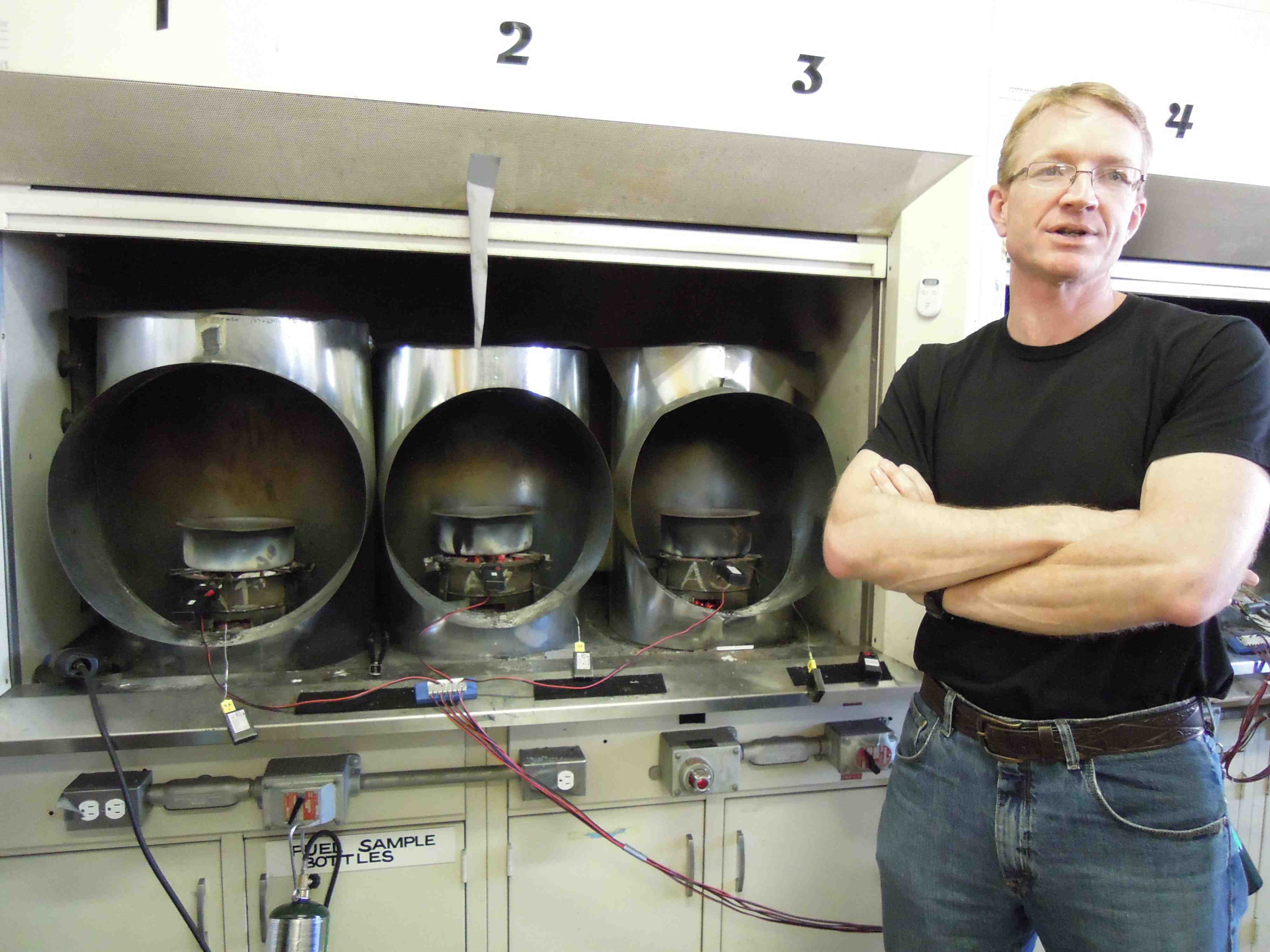
Craig Jacobson in the testing labs of Point Source Power. (Photo by Julie Chao/Berkeley Lab)
Craig Jacobson in the test labs of Point Source Power. (Photo by Julie Chao/Berkeley Lab)
“In the developing world, 2.5 billion people cook with solid fuels every day. We decided to piggyback on that ritual,” said Craig Jacobson, CEO and co-founder of Point Source Power, based in Alameda, California. “Our fuel cell is made from low-cost materials and is very tolerant of contaminants, things like sulfur and carbon, which would kill most other fuel cells.”
Jacobson co-invented the fuel cell in his 13 years as a materials scientist at Berkeley Lab. Working with Steve Visco and Lutgard DeJonghe, both still affiliated with the Lab, their breakthrough was in finding a way to replace most of the ceramics in the fuel cell with stainless steel, a far cheaper and more durable material.
“Ceramics are typically brittle and relatively expensive to process and assemble into systems,” Jacobson said. “We got rid of 90 percent of the ceramics, keeping only a very thin functional layer, about half the thickness of human hair, to serve as the electrolyte.”
As a result, Point Source Power’s fuel cell is rugged, being able to withstand welding and thermal shock. That makes it cheaper to manufacture. It can also start and stop in a matter of seconds. “Fuel cells have been around for over 50 years—they work great. There are only three problems with fuel cells: cost, cost and cost,” Jacobson said. “Our philosophy is, let’s get rid of those costs and make a fuel cell that can run on anything that burns.”
Jacobson left Berkeley Lab in late 2008 and co-founded Point Source Power with three other Berkeley Lab scientists, two of whom have since left the company. The other co-founder, Mike Tucker, splits his time between the company, where he serves as chief technology officer, and the Lab, where he is a scientist in the Environmental Energy Technologies Division.
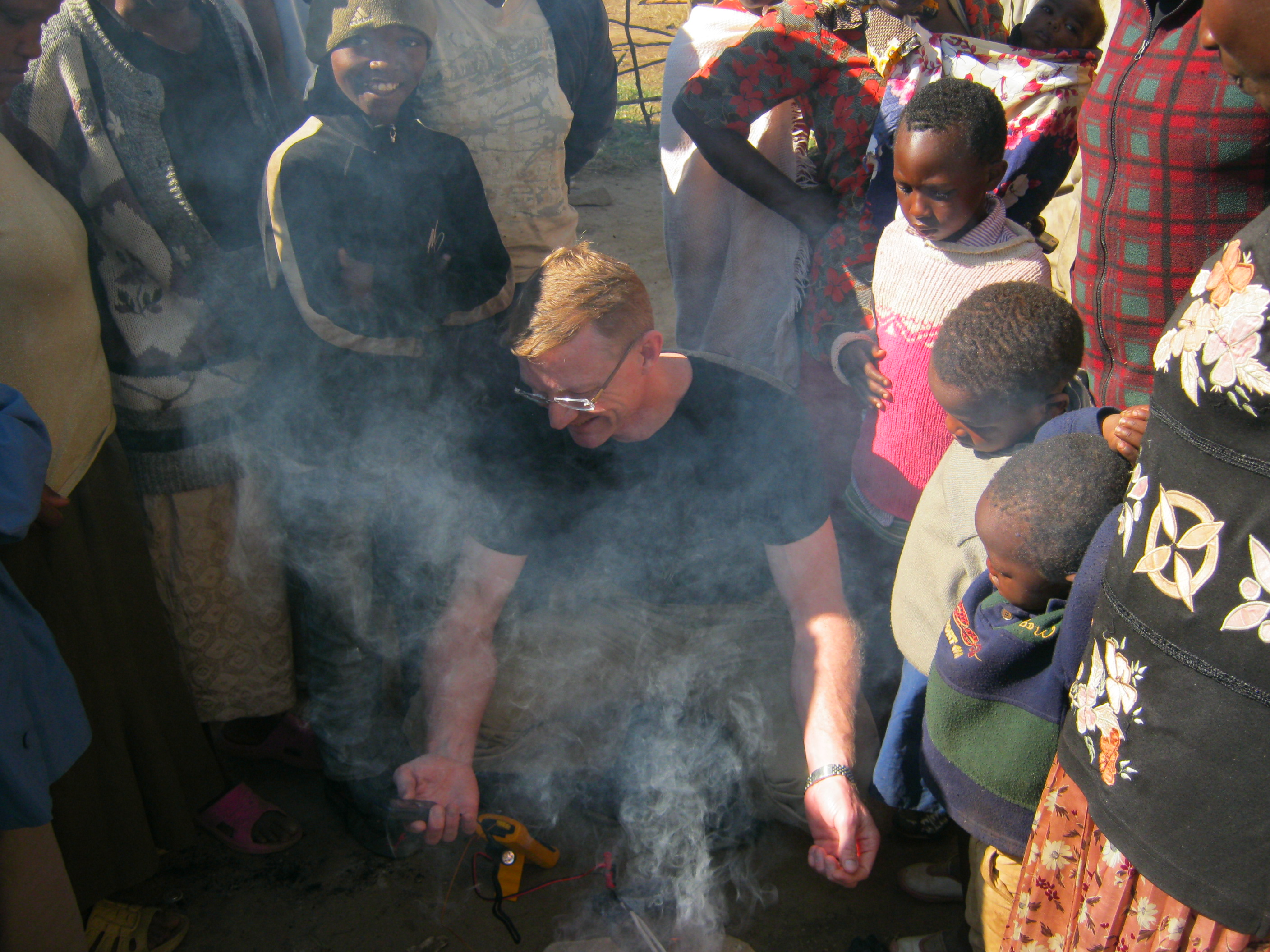
Jacobson demonstrates the VOTO charger in Kenya
Jacobson demonstrates the VOTO charger in Kenya. (Kenya photos courtesy Jacobson)
“We wanted to make a company that makes a difference,” Jacobson said. “And in markets with off-grid power, they pay a premium for electricity. They will pay per watt-hour what we pay per kilowatt-hour, but they don’t need nearly as much electricity. That was a light bulb that went off.”
Indeed, the light bulb in Point Source Power’s device, which it calls VOTO, provides longer and better quality light than the kerosene lamps commonly found in the developing world. Moreover it doesn’t emit the unhealthy pollutants and greenhouse gases that kerosene does.
Point Source Power is licensing a portfolio of more than 130 patents from Berkeley Lab. For a year, they worked out of Jacobson’s garage to develop their product and also went to India and Kenya to test the market. In 2010 Khosla Ventures invested in the startup.
The company now has nine employees working in a low-rise building on the old Alameda Naval Air Station. It is starting manufacturing in preparation for commercial release of the VOTO in Kenya this year. Jacobson has been to Kenya a number of times to conduct field trials and obtain input from both users and distributors.
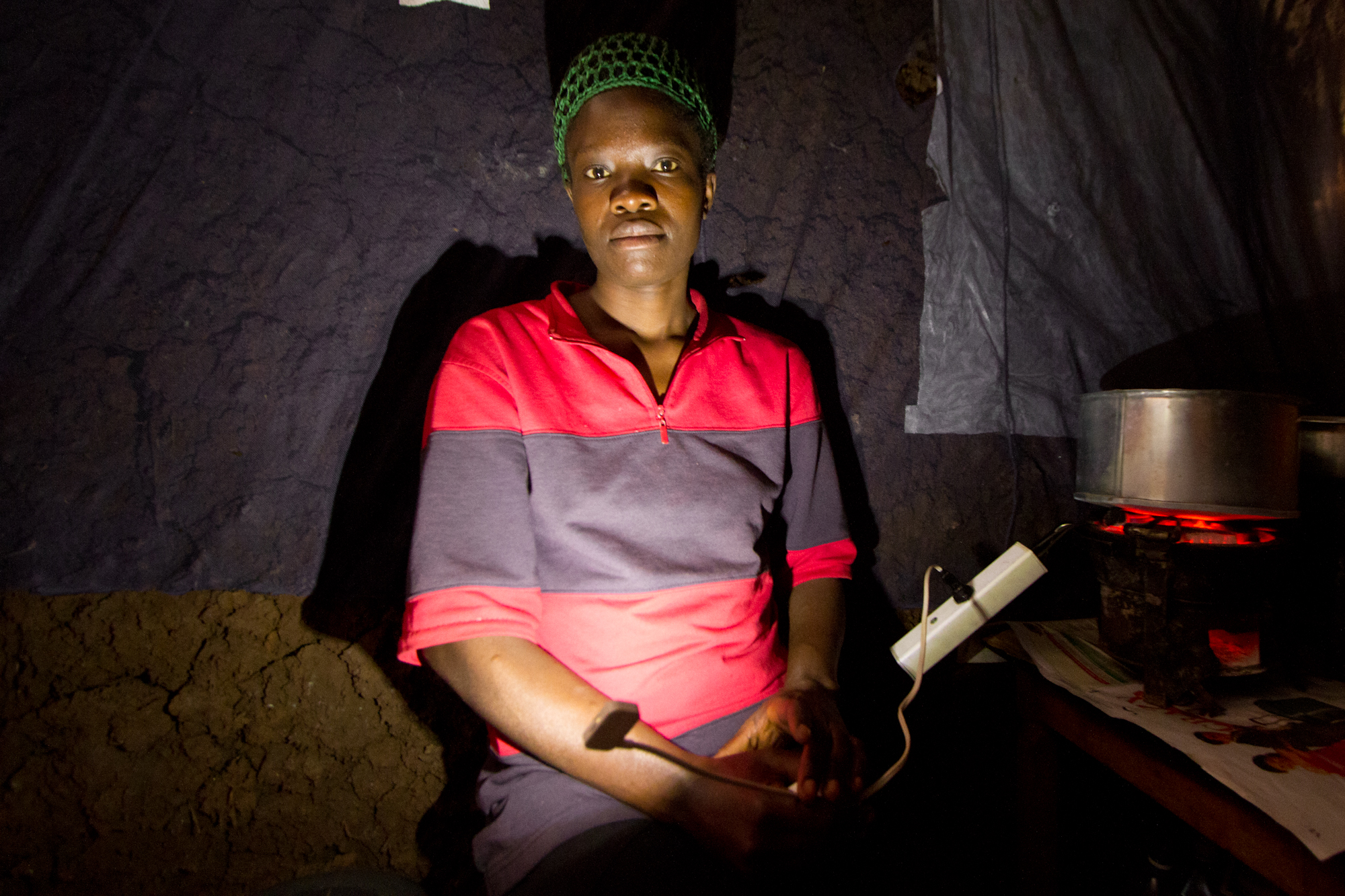
A woman in Kibera, xxx
A woman in Kibera, the largest slum in Nairobi, tries out an early version of the VOTO charger.
“There’s a lot of enthusiasm,” he said. “They’re fascinated by it. It’s like magic—you put a box in a fire and you get electricity out. People get it and enjoy doing it.”
The handle will retail for about $17 and the fuel cell for about $7. Like all fuel cells, the main limitation is its lifetime—it will last only three to four months with regular use. But given that families spend $8 to $12 a month on kerosene, “within less than two months they’ll get their money back and also get more convenience and save time,” Jacobson said.
Later this year Point Source Power plans to release a version of the VOTO for the U.S. outdoors and camping market, which will also allow charging of rechargeable batteries. Further down the road, Jacobson said the company may go into the backup power market, developing the fuel cell for natural disaster situations or larger scale off-grid systems, such as in agriculture.
“There’s a lot of waste biomass in the world,” he said. “If you can convert that to electricity it’s a good thing.”
Jacobson demonstrates the VOTO charger here.
# # #
Lawrence Berkeley National Laboratory addresses the world’s most urgent scientific challenges by advancing sustainable energy, protecting human health, creating new materials, and revealing the origin and fate of the universe. Founded in 1931, Berkeley Lab’s scientific expertise has been recognized with 13 Nobel prizes. The University of California manages Berkeley Lab for the U.S. Department of Energy’s Office of Science. For more, visit www.lbl.gov.


Pounds 2m waste-to-energy plant brings 250 jobs


THE figurehead for the region's processing sector has welcomed news of a Pounds 1.2bn deal that will see a new power plant built on Teesside.
Merseyside Recycling and Waste Authority, Sita UK and Sembcorp UK have announced plans to develop a Pounds 200m facility at Wilton International to turn Merseyside's household waste into green energy.
Called Wilton 11, the proposed development will create 50 permanent new jobs and sustain around 200 more during the three- year construction of the new facility, which, once in operation, will manage more than 430,000 tonnes of non-hazardous household waste each year from Merseyside and Halton.
The news comes a day after Teesside suffered a major blow with Sabic UK announcing the loss of 110 jobs at its Redcar operation.
As details of the development were unveiled, Professor Stan Higgins, chief executive of the North East Process Industry Cluster (Nepic), said: "This is fantastic news for Sembcorp and its partners.
"Wilton 11 recovering energy from waste is hugely encouraging for Teesside, highlighting the region's industrial infrastructure and engineering capabilities which are so important in the delivery of such a project.
"This project comes with a 30-year contract providing steady jobs on Teesside, not only for the 50 direct employees at Wilton 11 but also the support functions involved in running all aspects of a business on Teesside internally and via the supply chain."
The contract is worth Pounds 1.18bn over 30 years with the Merseyside and Halton Waste Partnership; joint venture partners are Sita UK, Sembcorp Utilities UK and I-Environment, which is a subsidiary of Itochu Corporation.
Two key facilities are to be built - a rail-loading waste transfer station in Merseyside and the new energy-from-waste facility on Teesside, both of which have planning permission and expect to be up and running by 2016.
Waste will be transferred into enclosed containers on Merseyside and arrive at Wilton International by rail, where it will be processed to generate electricity for the equivalent of 63,000 homes.
In all, some 90% of the contract waste managed by the Sita Sembcorp UK consortium will be used to produce energy instead of being dumped in landfill sites - a saving of some 130,000 tonnes of carbon emissions.
David Palmer-Jones, chief executive officer of Sita UK, said: "The two new facilities that we will develop will enable all of Merseyside's household waste to be put to good use." Dr Douglas Annan, senior vice-president and site director of Sembcorp Utilities UK, added: "As well as creating jobs and bringing new investment to the area, Wilton 11 will produce electricity using a sustainable fuel source, reuse materials preventing them going to landfill and provide renewably-sourced heat for use in power generation or for distribution to our industrial customers on site."
Wilton 11 is hugely encouraging for Teesside, highlighting the region's engineering capabilities
Copyright 2013 ProQuest Information and Learning
All Rights Reserved
ProQuest SuperText
Copyright 2013 MGN Ltd.

48 MW Waste to Energy Plant Planned for Jawaharnagar, India

23 April 2013
48 MW Waste to Energy Plant Planned for Jawaharnagar, IndiaHyderabad, India based waste management and environmental services company, Ramky Enviro Engineers, is to begin construction of a 2400 tonne per day 48 MW waste to energy facility in Jawaharnagar, according to a report by The Hindu.
The report said that the company is the Greater Hyderabad Municipal Corporation’s (GHMC) private partner in developing the Integrated Municipal Solid Waste Management Project, which will see the construction of the four stage waste to energy plant.
The waste to energy facility will reportedly benefit from the technological support of Chinese waste to energy specialist Sanfeng-Covanta - a joint venture 40% owned by New Jersey based Covanta Energy (NYSE: CVA).
According to GHMC Commissioner M.T. Krishna Babu, if all government approvals for the planned facility are secured it is believed that the plant could be operational within two years of construction starting.
Babu is also reported to have said that emissions from the incinerators will be Euro pollution standards compliant with little of sign of any smoke or particulate matter.
Explaining the potential benefits of the plant, A.K. Parida, director general of the independent Indian environmental research and advocacy organisation is reported to have urged the government to relax a rule prohibiting power plants within 25 km of the 'biological zone'.
“Since it’s garbage-to-power plant and is located 15 km from the declared bio-zone we have sought an exemption,” he was reported to have said.
The cost of building all four lines of the proposed facility was estimated at Rs. 6.24 ($115 million).


Read More

Three 1000 tpd Waste to Energy Plants Sought in Mumbai, India
International companies have been invited to submit proposals for three 1000 tonne per day waste to energy facilities in Mumbai.
Biowaste Gasification Fuels Low Cost Cooking Stove in India
A cooking stove fuelled by gasified biowaste has been approved by the Indian Ministry of New and Renewable Energy and launched in North East India.
Contract for 600 TPD Integrated Waste Project in Raipur, India
Kivar Environ, which also specialises in managing waste water, has signed a Concession Agreement with Raipur Municipal Corporation for the implementation of Integrated City Sanitation and Municipal Solid Waste Management Project in Raipur.

Monday, 22 April 2013

The future of WTE - The new waste-to-energy developments that will change the industry


Waste to energy is growing in popularity, so what technologies are emerging as a response to this? Felicia Jackson looks ahead and discusses new developments
The WTE market is currently growing rapidly around the world. While it has traditionally been a mature and slow-growing market, a perfect storm of fears about pollution, the impact of climate change and the growing focus on finding non-fossil fuel sources of energy, has meant a renewed focus on the opportunities available.
There have been concerns raised about WTE. Namely that using waste for fuel can encourage wastefulness and discourage recycling, and that there are harmful by-products of the transformation of waste to energy, including toxins and greenhouse gases. Yet new, cleaner technologies developed over the last few years can often avoid the generation of such by-products providing an effectively carbon neutral process.
There are a number of issues for developers in selecting a new technology: the efficiency of the process itself, the reliability and lifetime of the waste feedstock, local environmental impact in terms of by-products, as well as planning and consumer and media opinion. Some technologies provide only part of the process. For example, mechanical biological treatment (MBT) or autoclaving treats and sorts residual waste, resulting in streams of recyclable materials, organic materials (often suitable for composting), other materials suitable for use as refuse-derived fuel (RDF) and other inert materials. However, as part solutions to the waste issue, they do leave some fractions of waste for landfill and the resultant RDF is frequently used in straightforward incineration.

Today’s technology

A number of new market technologies, such as anaerobic digestion, pyrolysis and gasification, are in the process of being deployed. These technologies provide the potential to recover products from the waste stream which complete incineration would not allow – and a significant proportion are focusing on biomass waste. Pyrolysis involves heating waste in the absence of oxygen at very high temperatures, which breaks down complex molecules and resultant gases are then passed into a combustion chamber where they are heated (in the presence of oxygen) at temperatures around 1250°C. The process produces liquid oil which is used as a fuel, as well as gases that can be used to run steam turbines, and chars. Gasification can be used with a far broader range of feedstock, and simply involves heating wastes in a low-oxygen atmosphere to produce a synthetic gas, which can then be used to power a steam turbine.
With the advent of wider usage of technologies, the crucial questions are scalability and the cost-effectiveness of each technology. One of the reasons for the success of incineration is the lack of IP required to develop a plant – this makes it simpler and relatively cheaper than some of the more technically advanced forms of WTE for waste management companies and local government to implement. Yet improvements in the technologies, especially increasing efficiencies with new catalysts and enzymes around improving bioreaction and pyrolysis technologies are beginning to make an impact on the cost.
Another crucial requirement for the successful development of waste-to-energy plants is to secure a sufficiently robust waste stream and, to a great extent, different forms of technology will be appropriate to one of a number of different waste sources.
Operationally, incinerators are reasonably immune to variable input characteristics (they’ll burn most things) but they are vulnerable to feedstock changes. They may lose energy content if, for example, plastic packaging disappeared over the long term.
Landfill gas to energy has proved popular, especially given that the dominant gas emitted from landfill, methane, has a global warming potential 23 times that of carbon dioxide. However, the growing concern about the pollutant impact of landfill means that there will be far less landfill available in the future, which is likely to have a dramatic impact on its role as an energy generator. This is an additional problem with incineration, since ash residues from the process can be as high as 25% by volume, most of it can go nowhere but to landfill. Chars resulting from the pyrolysis process, for example when using rubber waste such as tyres, may also generate toxins and require landfilling.
The necessary footprint of MSW incineration sites can also cause problems. The majority of waste management and incineration sites have a large footprint, with waste being trucked in from the surrounding region. Such plants can have high operating and capital costs, requiring long payback times, which can expose them to a higher risk of waste stream content changes. The large scale of such plants can make the power generated easier to integrate into existing grid networks but low efficiencies mean that large quantities of waste may need to be trucked in from the surrounding regions. And that need for large waste streams causes concern regarding the impact on local waste reduction or recycling streams.

Economies of scale

It is the large-scale nature of such waste management programmes that is beginning to be questioned. There is a growing demand for locally generated power, and an even stronger demand for local waste solutions. Not only is there an accepted need to reduce the amount of waste that our economies generate, but the logistical requirements for large scale waste transportation have a significant carbon impact – another increasing concern to industry and government. If the energy from waste market is going to grow, it’s important to be able to deliver plants with a small footprint, that can generate efficient power and heat for a local district or industrial area, and that have an ongoing and reliable fuel source. This will not only contribute to renewable energy targets, but also counter many arguments which result in planning opposition.

Scale model made for a potential 100,000 tonnage plant Click here to enlarge image
One of the key things that needs to be resolved is how to finance such new infrastructure. Few of the existing large waste management players have the capacity, the finance or the technologies to meet all the new waste targets on their own, let alone those likely to be enforced in the next few years. New technologies and new ways of financing necessary facilities do exist however, with new businesses and project financiers eager to follow the success of the wind market with the waste and waste to energy market.
Traditional large scale incineration has been relatively easy to fund, as the capital costs are clear, the technology well known, and the revenue stream (through gate fees from local or regional governments) easy to ascertain. This makes them appealing to traditional public, project and debt finance. With many of the new technologies, investors can be concerned about long term revenues, as there are few plants that have been up and running for a long time, and many governments prefer centralized solutions operated by businesses with large resources. This puts pressure on small scale developers – they can’t bid for large scale waste management contracts on the same terms as the established industry players. This in turn can deter equity investors, and make it problematic to raise either debt or equity funding.
Yet they can also have significant advantages over large scale waste management solutions, financially and environmentally. Smaller plants generate fewer waste miles and certain new technologies do not face issues with the leachate and toxic fly ash so frequently associated with incineration. They’re also cheaper to build and can be scaled up as needed. As they are usually privately financed, local government need not take on any capital expenditure – the plants are financed on the basis of agreed revenue-bearing contracts such as gate fees for MSW.

One solution: Gasplasma

An effective WTE plant should be able to generate a number of revenue streams: gate fees for the waste it receives, generated electricity which is sold to the local grid on long-term power purchase agreements, and potential revenue from the sale of recyclables removed or the sale of heat to co-located industries. This approach is of growing interest to the major European energy providers, who must boost their renewable electricity output 15%-20% to meet the targets. With commercial waste predicted to increase by 50% by 2020, the ability to build small plants in industrial areas could transform the energy landscape with local waste being used to produce local electricity.

Plasmarok, a valuable by-product of the Gasplasma process Click here to enlarge image
One example of this is Advanced Plasma Power’s Gasplasma process, which combines two well-established technologies, fluid bed gasification and plasma arc conversion. APP’s original parent company Tetronics uses plasma successfully in 33 sites around the world, in vitrifying incinerator bottom ash and hazardous waste, as well as in metals recovery. Gasification has been well proven in a number of markets from coal to biomass. Aside from the initial power supply from the local electrical grid, the whole process is self-sustaining after the initial electrical charge is used. It is environmentally friendly, and it produces materials that have commercial applications and thus can generate further profit.

A model of how a full scale APP plant would look Click here to enlarge image
An average 100,000 tonne APP plant could generate six steady revenue streams from each site: gate fees for the waste it receives; the sale of all recyclables removed; the electricity generated (which is sold to the local grid on long-term power purchase agreement); the heat sold to industries that co-locate on the same site; double ROCS under the UK Renewable Obligation scheme; and the sale of the glassy material, Plasmarok, which is produced by the process and can provide a return as it is sold as building material or aggregate. A plant would generate 11.5 MW of electricity, using 4.5 MW to run the plant, with the remaining 7 MW exported to the local grid. This is enough for over 12,000 homes. With heat recovery, the process is over 65% efficient.
Even better, for those authorities’ conscious of the need to cut their carbon footprints – its carbon contribution to the environment is virtually nil. Analysis of the APP process has been shown to have a ‘negative’ carbon footprint in comparison to other forms of energy generation, produce virtually zero emissions and has the highest landfill diversion rate of any available technology, making it very attractive to local authorities.
While plasma technology has been in use for many years it has only recently been developed as a waste management solution. This was partly because the conventional landfill approach was considerably less expensive, even with transportation costs and gate fees, and there was no regulated requirement for low-carbon energy. However, with increasing landfill diversion targets and renewable energy targets, the relative cost of the technology has been transformed. This is making plasma gasification one of the most potentially exciting opportunities in the sector.

The waste-energy partnership

There is no question that the energy mix of the global economy is in flux, and we are going to see an increasingly broad range of solutions, ranging from fuel cells to the implementation of a hydrogen economy. A great deal of work is currently being undertaken at the cutting edge of technology in developing flexible or multi-purpose fuels, and billions of dollars are being invested to bring these opportunities to market.

Post-sorted waste (recyclables removed, dried and shredded) travelling up the conveyer belt to the gasifier Click here to enlarge image
Until those technologies become widely available, we must accelerate our implementation of those technologies which work today. Energy and waste policy are not correlated anywhere in the world, but there is a significant amount of energy stored in waste and that is increasingly being recognized in a resource-constrained world. Perhaps we need to accept that the waste and energy industries cannot, and should not, be mana

Friday, 19 April 2013

Double plasticPlastic - what is it and what are its characteristics?Plastic is a product that can not decompose. Molded plastic products can take different shapes in some process or processes of pottery. Modern plastics (or CO) have several interesting features, balance of power and weight, Zifa better withstand heat, electrical insulating materials, unaffected by acids to mention just a few features. These CO are produced in a series of repeating units (units) Popularly known as monomers. Naviwango polymer structure and identifies its characteristics. There Linea CO (the structure of the soft one), branched CO (which have a straddle) is a thermoplastic that is, are placed in warm fleshy. Cross-Linked CO (which have two or more chains united side by side) are thermosetting, meaning that, they are placed in hard to heat.
The structure of the soft one
that contain branching
chains that contain two or more united side by side
Figure 1: Structures of polymer Thermopastics creates 80 percent of plastics produced today. Examples of thermoplastics include: • High DENSITY Polythene (HDPE) which is used to make water pipes, fuel tanks, bottles, models and children's toys such as dolls. • LOW DENSITY Polythene (LDPE) which is used to make plastic bags and other flexible plastic container. • Polyethylene TEREPHTHALATE (PET) which is used to make bottles, carpets and equipment to load foods; • polypropylene (PP) tubes in a container of food, yarn battery, crates of soda bottles and spare parts for vehicles. • Polystyrene (PS) that are used on containers of dairy products, tape cassettes, cups and plates; • Polyvinyl Chloride (PVC) is tumuka forming skeletons window, cassette radio, cups and plates, insulating cables electricity, bank cards pharmaceutical packing equipment. There are hundreds of types of thermoplastic polymer, a new type zinabuniwa.Katika still developing countries, there are different types of plastic used, however this rate is not very high.
Practical Action, The Schumacher Centre for Technology and Development, Bourton on Dunsmore, Rugby, Warwickshire, CV23 9QZ, UK T +44 (0) 1926 634 400 | F +44 (0) 1926 634 401 | E infoserv@practicalaction.org.uk | W www.practicalaction.org ______________________________________________________________________________________________ Practical Action is a registered charity and company limited by guarantee. Company Reg. No. 871954, England | Reg. Charity No.247257 | VAT No. 880 9924 76 | Patron HRH The Prince of Wales, KG, KT, GCB
Photocopying Plastics
Thermosets are 20 percent of plastic produced. Hufanywa difficult that can not be melted again or re-molded and therefore are very difficult to use again. Sometimes be crumbled to atoms and used to fill the background. These include: polyurethane (PU)-which makes products such as pillows bedding and automobile seats, epoxy - sports equipment, electrical equipment and vehicles; phenolics - refrigeration, handles of spoons and pans, spare parts for cars (The World Resource Foundation). Nowadays, plastic raw material comes very petrochemicals, plastics although originally came from cellulose (cellulose), a basic ingredient in living plants. Why kudurufisha plastic? In western countries, the use of plastics has increased dramatically in the past two or three decades. In the category of European and American continents, the limited resources of oil are used to make different kinds of plastic in bulk. Many products containing plastics can last for a period of less than one year before kutupwa.Mara many, these plastic cast after use. Plastic possession again these are expensive operations. In the industrial sector (manufacturing of automobiles, for example) there is a great need in double plastic for economic and environmental reasons, while many companies zikianzisha technologies and strategies to replicate the plastic. Plastic not only due to aslimali itengenezwi that can not kutengenezeka again, but often does not decay (or processes tend to slow its decay). This means that plastic garbage is kind of rubbish in landfill sites and lasting inakotupwa place for many years without decay. • • • • More than 20,000 plastic bottles are needed to get a ton of plastic It is estimated that 100 million tons are produced every year. On average, European citizens are given 36kg of plastic each year. 4% of European yatumikayo oil is used in the manufacture of plastic products. Some plastic bags are made from 64% plastic iliyorudufiwa. Plastic packaging products to contribute 42% of the use of plastic and are very small amounts of these plastics that be doubled


Although there is also growth in the use of plastics in developing countries, the rate of plastic consumption in developing countries is very low When the what in the developed world. However these plastics are made from expensive raw materials imported from abroad. There is wide scope and because the plastic double in developing countries for several reasons: • The cost of employees is low. • In many countries, there is a tradition for repeatedly using the product or photocopying, which is linked to the process of collection, separation, purification and utilization of waste or products zilizokwisha used. • There are often 'informal sector' which basically fits in dealing with such urudufu.Fursa in bringing revenue is used kuwanufaidi poor people in urban areas. • There are a few rules to regulate product standards zilizorudufiwa. (This is not to say that these standards could be lower - the user of the product would always want a certain level of quality). • The cost of transportation is often lower, with carts and oxen used inayokokotwa. • Lower cost of raw materials provides a competitive advantage against the world of manufacturing. • Use creativity of man-made machine makes low cost of manufacture of the product.
2
Photocopying Plastics
In developing countries, the scope of double plastic plastic yanapanuka with applicable rate continues to rise.
Plastic to replicate
Not all types of plastic that can kurudufiwa.Kuna 4 types of plastics that can be doubled: • Polyethene (PE)-high-and low DENSITY DENSITY Polythene. • polypropylene (PP). • Polystyrene (PS). • Polyvinyl chloride (PVC). Litokanalo common problem with double plastic is that plastic is made with more than one polymer or there may be other links to vinavyoongezwa for reinforcing plastics. This condition can make activities difficult double.
Sources of plastic garbage
Industrial waste can be obtained from the manufacture of large quantities of plastics and packaging industries. Waste derived from manufacturing it has a good reputation to be doubled and cleaned. Although the rate is a bit rubbish, so rates continue to increase due to increased consumption and thus manufacture increases. Industrial waste is coming from the garage, shops including general stores. Many plastics are derived from these sources is polyethylene (PE), which is dirty.
Figure 2: Combination of plastic garbage before duplicated. Photo by Practical Action / Zul Other Junk plastic can be found in fields and nursery in urban areas. These are a pack (plastic or paper) or construction equipment (balls irrigation). Urban municipal waste can be collected from people's homes (takatataka home), traffic, garbage collection centers or areas where garbage is thrown full. In cities across Asia, this kind of garbage is available to and may be collected from the streets or homeless people to make plans with people. (Lardinois 1995).
3
Photocopying Plastics
Identification of different types of plastics.There are various simple experiments that can be used to distinguish between normal type CO in order to be separated for the purposes of the preparation. Attempt to water. After adding a few drops of soap for a certain amount of water they take a small piece of plastic to see if kitaelea. Attempt to burn. Hold a piece of plastic in four irrigation schemes or shovel or knife and then put it on fire. Is plastic So, inachomeka? If inachomeka, fire ri what color? Attempt to hand fingernail. Have plastic samples may kukwaruzwa to hand fingernail. AttemptBurn Water
PEFloats Hot blue flame of yellow ones Dissolves and drops fall like a candle
PPFloats Combustion yellow with blue stem the fall out.
PSHuzama yellow, black fire
PVC *Huzama yellow smoke
Nusa after burn
as a candle does not force winning PE
Sweet
Kwaruzika
Yes
No
No
A fire burns Haiendelei removed SODIUM HYDROXIDE No
* To prove PVC, touch and sample the hot piece of copper wire and then hold the wire in green moto.Moto due to the presence of chlorine in the sample is proof that it is PVC. To determine that the plastic is a type of thermoplastic or thermoset, take a piece of wire and kukiwekelea to the scene of the fire and kuifinyilia jekundo plastic hiyo.Iwapo on the wire you are through, then it is thermoplastic, if not upenyi, then it kind of thermoset. A system of secret United States also has been established to help identify the type of plastic. The system is based on the 'Recycle Triangle' which has a series of numbers and letters to help in diagnosis. More information is available from the Association of Plastics Manufacturers in Europe (APME). See Section address key at the end of this article.
CollectionYou consider about setting up a double to the Doro project, it is necessary first to investigate to make sure what kind of plastic tubes that can be collected, the type of plastic used by product developers (who will agree to buy products zilizorudufiwa), and the possibility of improved economic project. Methods of collection may be following collection The strategies provide tips: • Collection of plastic and other products (eg paper) from house to house. • Collection of platiki isolated from house to house (but all types of polymer). • Collection of house to house of only certain types of garbage. • Collection of waste from a facility such as market or church. • Collection from street kid to be paid. • Collection constant from the shops, hotels, factories etc. • Buy from machokoraa and gatherers in the garbage landfill sites. • Collect yourself.
4
Photocopying Plastics
Collection method will depend on the level of your project, the existing capital to start the project, methods of transport and so on. Duplicate of plastic trash - processes and technology for small projects. • cleaned and placed in makundi.Ujuzi will be used will depend on the size of the project and the type of trash collected., But in the very first level will involve cleaning the plastic by hand and set aside the plastic group. Cleaning machines and sun-drying can be used in projects of a variety of plastic mikubwa.Utenganishaji group can be either in a group of polymer (thermoset or thermoplastic, for example), depending on the type of products (glass, paper, plastic, etc.), color and so on.
The first step to improvement. Once plastics have already collected, will be needed
Image 3: Collection of Junk @ World Resource Foundation

How to Start a Paper Recycling Plant

Recycling paper is a profitable venture as waste paper is a readily available raw material. Recycling reduces the wastage of water in paper production and reduces air and water pollution. The process of recycling paper involves soaking waste paper and pulp to separate the fibers. The pulp is then screened to remove detrimental materials like pins. The pulp is then de-inked and thickened before it is washed. If white paper is required, the pulp is bleached before being rolled into sheets. You can recycle paper mechanically or by using automated machines.

Things You'll Need

  • Waste-paper storage container
  • Conveyor
  • Heating container

Instructions

    • 1
      Conduct market research. Find out who the prospective buyers of recycled paper will be. Recycled paper products are ideal for newspaper firms, stationery industries, schools and offices using paper products. Your products will include paper bags, tissue paper, envelopes, boxes and newsprint paper.
    • 2
      Get capital. Initial capital outlay will depend on whether you'll recycle the paper manually (slow but cheap) or automatically (fast but expensive). You can use a loan from a financial institution that you'll repay as you begin selling paper products. You can also use personal savings. Operation costs will be greatly subsidized when the papers begin selling.
    • 3
      Register the business. Obtain a business license from your state. Obtain a Federal Employer Identification Number (FEIN) to allow you to employ staff at your plant. You can also register your business with the Paper Industry Association Council.
    • 4
      Set up the plant. Purchase the conveyors, boilers, pulp-holding containers and install them at the plant location. Chemical feeder pipes and power installations have to be installed on site. Enlist a plant/mechanical engineer to oversee the installation. Conduct test runs to fine-tune the plant before full operation begins.
    • 5
      Hire staff. For large automated plants, you'll need engineers, crane operators, industrial technicians, packaging staff and drivers for transport. Smaller and mechanical plants may only require loading, operation and packaging personnel.
    • 6
      Market your products. Advertise your products with newsprint businesses and stationery users like offices, schools and printing firms that deal in papers. You can also create an easy-to-navigate website for online clients, besides advertising in the electronic media.

How to Start an e Waste Management Recycling Business Plant


With the onset of globalization and modernization, it is inevitable that huge amounts of garbage will be thrown away from homes every day. Because of this fact, it is important that the percentage of garbage that will be managed and recycled would somehow be equal to those which cannot.

The benefits of waste management recycling

Recycling not only helps rid the world of garbage but can also help in making sure that there are less polluted lands.  With the increased awareness in environmental protection, you as a business owner can take the opportunity and start your own waste recycling plant.
This article is all about how to start a waste recycling business.  Listed below are the different things you should know if you plan on starting such business. But before I go into the details of starting a e-waste management recycling business, I want to emphatically state that the information provided in this article does not in any way replace the need for you to conduct a feasibility study, write a business plan and do your own due diligence. Secondly, the information shared in this article is applicable to any locality; be it USA, Canada, UK, Nigeria, Ghana, etc. Without wasting your time, below is an in-depth guide to starting your own e-waste recycling business with little or no money.

   How to Start an e Waste Management Recycling Business Plant

1.            Now that you have made up your mind to learn how to start a waste recycling business, the first thing you should decide on is how to establish your business. Make sure you know the types of businesses yours can take on. You can either run it independently; as a co-owned business; a partnership; or a limited liability company (LLC). You should take steps to obtain a license and permit for your business.
2.            If you are just starting out, you should know that it is possible for you to commit to recycling everything recyclable. However, since you are still starting, it is a good idea to start recycling paper first since you still have limited capital and you might not have all the necessary resources at first. As time goes on, you may gradually expand to include other recyclable materials like computers, plastics, organic, nylon, bottles, food waste, green waste, paper, wood, construction waste, electronics and others.
3.            In learning how to start a waste recycling business, make sure that you get the proper certification. There are different regulations for different states and make sure to know how you can get certified in the state you would want to set up your waste recycling plant. Certificates are important for buying or selling CRV-labeled containers.
4.            Find an appropriate location for your waste recycling business. You might want to choose a spot where people could be allowed to drop off their recyclable materials and where you can pick up on a regular schedule to be taken to your main recycling facility. You can either choose a warehouse or even a small stall close to commercial establishments like supermarkets and restaurants.
5.            Buy or lease the necessary equipment you need for recycling. In order to start a waste recycling business, it should be clear to you that you cannot recycle materials without having the proper machines to be able to do so.  You would need weighing scales, huge bins, trucks, and some equipment for your office. You should get your weighing scales certified since they will be checked periodically.
6.            See if you will find other competitors in the area.  If there are, see if they have the same recycling techniques you will be employing. If their services are limited, you would be gaining more profit if you offer a wider range of services.
7.            Advertise your business by creating a website, distributing handouts and posting ads in the newspapers.
As a final note, the most important thing to consider when starting a waste recycling business is the costs and fees involved with the business. This would include business license fees, state income tax, business tax certificate, employee payroll taxes, federal income tax, and other types of fees. Check with your local or state government for the requirements.

Starting a Paper Recycling Plant

The best way of learning things is, trying them by ourselves. Starting a a paper recycling process is the simplest among the other scrap recycling processes . For example there is a paper recycling plant in India by the name TARA (Technology And Rural Advancement) where certain schools have installed their paper recycling plant and using it extensively. It's clear now how simple paper recycling is. So if they can do it, there is no reason that we can't do it.  Paper recycling in a small scale will be easy. What about the process if it's done as a business? Simple, everyone can earn a respectable income by collecting and selling paper to the recycling plants. And as everyone knows this does not require any specialized skills or great technical education.

"A man willing to work, and unable to find work, is perhaps the saddest sight" is an old saying. But things have changed a lot nowadays. Anyone willing to work (educated or not) can get into the process of paper recycling. Believe it or not there are certain paper recyclers making more than $100,000 per annum. It's hard to believe, but that's true.


"A business that makes nothing but money is a poor business". But in case of the paper recycling industry, people can earn money for their livelihood and also it provides them an opportunity to preserve the environment. Sounds great!


So what will be the investment requirements to start a recycling plant and are they affordable? Definitely the answer is yes. The following are the requirements to start an own paper recycling plant. First of all the source is very important. But in case of paper that is not a problem at all. As we all know we live in a paper world. Second thing is collection of the material. The collection mode depends upon the scale of the business establishment we plan to begin. Large scale plants will need trucks and pickup vans. Small scale plants can hire people for collection. The main concern is the plan of transportation. An improper route of operation of collection can affect the business adversely. Then comes the requirement of land. It also depends upon the recycling plant. Finally the machinery. There are a lot of machinery suppliers for this process in the Country itself. And the important requirement of any industry is publicity. "The Internet is the world's largest library. It's just that all the books are on the floor". So effective advertising can be done on the internet. Anyway don't waste time learning the "tricks of the trade." Instead, learn the trade.

The process of paper recycling is a ten step process as below:
Adding water and applying mechanical action to separate fibers from each other.(PULPING)
Using screens, with either slots or holes, to remove contaminants that are larger than pulp fibers.(SCREENING)
Spinning the pulp slurry in a cleaner causes materials that are more dense than pulp fibers to move outward and be rejected.(CENTRIFUGAL CLEANING)
Passing air bubbles through the pulp slurry, with a surfactant present, causes ink particles to collect with the foam on the surface. By removing contaminated foam, pulp is made brighter. This step is sometimes called deinking.(FLOATATION)
Mechanical action is applied to fragment contaminant particles.(DISPERSION)
Small particles are removed by passing water through the pulp. (WASHING)
If white paper is desired, bleaching uses peroxides or hydrosulfites to remove color from the pulp.
The clean (and/or bleached) fiber is made into a "new" paper product in the same way that virgin paper is made.(PAPER MAKING)
Process water is cleaned for reuse. (DISSOLVED AIR FLOATATION)
The unusable material left over, mainly ink, plastics, filler and short fibers, is called sludge. The sludge is buried in a landfill, burned to create energy at the paper mill or used as a fertilizer by local farmers. (WATER DISPOSAL)


BOTTOM LINE:
Improvement usually means doing something that we have never done before. So why waiting for someone to start the business first? Paper recycling needs very low investment and many people also get benefited by getting employments. The main thing in this industry is publicity and exposure to the industry. The are lot of websites that provide promotion and bundles of information regarding this field. Like the saying "National borders aren't even speed bumps on the information superhighway", certain websites like www.recycleinme.com provide lot of information about the recycling industry, provide trends in international market and also they provide lot of support to improve the firm. Still do you think all these are impossible? Then it's like "THE IMPOSSIBLE IS OFTEN THE UNTRIED".

Indian Researchers Create Low-Cost Bricks From Recycled Paper Mill Waste

Rahul Ralegaonkar, Sachin Mandavgane, Visvesvaraya National Institute of Technology, vnit, rpmw, recycled paper mill waste, cement, bricks, paper, etp, sludge, indiaWhile recycling trash is preferable to simply chucking refuse into the dump, the process still creates tons of byproducts that end up making their way to the landfill. Fortunately, Professors Rahul Ralegaonkar and Sachin Mandavgane of the Visvesvaraya National Institute of Technology in India (VNIT) have developed a way to create paper bricks from recycling waste. Made from 90% recycled paper mill waste (RPMW) and 10% cement, the mixture is mechanically mixed and pressed into molds and then cured in the sun. The brilliant recycled building material is low-cost means of eking more efficiency out of an already good practice.
Rahul Ralegaonkar, Sachin Mandavgane, Visvesvaraya National Institute of Technology, vnit, rpmw, recycled paper mill waste, cement, bricks, paper, etp, sludge, india
After visiting a recycling plant in 2009, Mandavgane and Ralegaonkar discovered that 15% of the paper taken in was left to sit in a landfill as sludge. After bringing the slurry back to their labs at VNIT, they experimented with a mixture that would make a good building material. Their bricks are made from 90% recycled paper mill waste that has already been used successfully in false ceilings and partition walls. In addition to paper waste, the team has incorporated textile effluent treatment plant (ETP) sludge, cigarette butts, fly ash, cotton waste, polystyrene fabric, waste tea, rice husk ash, granulated blast furnace slag, and dried sludge from a waste water treatment plant.
“Recycle Paper Mills (RPM) contribute 30 percent of [the] total pulp and paper mill segment in India. With 85 percent being the average efficiency of RPM, 5 per cent waste (RPMW) is produced annually. RPMW which otherwise is land filled has been utilized to make construction bricks that serve a purpose of solid waste management, new revenue generation and earning carbon credits,” says Mandavgane.
Blocks made from these cast-off materials are half the cost of normal bricks and much lighter. Such inexpensive bricks would come as a great benefit to the Indian construction market, which has a 30% deficit in supply. The team is presently working on a waterproof coating for the bricks (so they can be used on housing exteriors) and determining the material’s efficacy in earthquake prone areas.

Thursday, 18 April 2013

Japan Adds 1,394 Megawatts of Clean Energy Capacity, METI Says


Japan, the world’s biggest importer of liquefied natural gas, added 1,394 megawatts of clean energy capacity, most of it solar, between April last year and the end of January, the Ministry of Economy, Trade and Industry said in a statement.
Meanwhile, applications have been approved for above-market rates for clean energy projects equal to more than a quarter of installed renewable capacity. Projects approved under Japan’s feed-in tariffs totaled 7,368 megawatts of capacity by the end of January, according to the statement.
Japan had 26,940 megawatts of clean energy capability at the end of 2012, according to Bloomberg New Energy Finance. Solar is the dominant form, accounting for about a third of all renewable energy, according to the data.
The additions follow the introduction of an incentive program begun in July to increase clean energy such as wind and solar after the 2011 Fukushima nuclear disaster.
The ministry approved non-residential solar projects totaling 5,749 megawatts, residential solar worth 958 megawatts, and wind worth 570 megawatts, according to the statement. Biomass, geothermal and small hydro accounted for the remainder of the applications.


American Progressive Bag Alliance Launches California Campaign Correcting The Record On Plastic Bags


SACRAMENTO, Calif., April 16, 2013 /PRNewswire/ -- The American Progressive Bag Alliance (APBA) today launched a campaign to educate Californians and policy makers on the negative environmental and economic consequences of banning plastic bags. The campaign, which includes television and radio advertising, will urge people to examine the facts about this issue before considering misguided policy proposals based on fabrications and exaggerations.
"To date, the debate on plastic bags has been supported by unfounded stats, junk science and myths. The reality is that American made plastic bags are a better choice for the environment and banning them will cause more harm to the environment," said Mark Daniels, chairman of the APBA. "If California wants to lead in the fight against global warming, banning plastic bags will have the exact opposite effect."
The campaign will communicate facts in order to set the record straight on environmental issues concerning plastic bags and their alternatives:
   -- Plastic bags produce fewer greenhouse gases than paper or cotton bags.[i] 
 
   -- Reusable bags cannot be recycled, are mostly shipped from overseas and 
      are made from foreign oil. 
 
   -- Plastic grocery bags require 70% less energy to manufacture than paper 
      bags.[ii] 
 
   -- The production of plastic bags consumes less than 4% of the water needed 
      to make paper bags.[iii] 
 
   -- Plastic bags generate 80% less waste than paper bags.[iv] 
 
   -- For every seven trucks needed to deliver paper bags, only one truck is 
      needed for the same number of plastic bags.[v] 
 
   -- American plastic bags are made from natural gas, not oil. In the U.S., 85 
      percent of the raw material used to make plastic bags is produced from 
      natural gas.[vi] 
This week, the Senate Committee on Environmental Quality will take up Senate Bill 405, a bill introduced by Sen. Alex Padilla (CA-20), which would prohibit California retailers from distributing plastic grocery bags and charge consumers a tax for paper bags.
The APBA is an organization representing the United States' plastic bag manufacturing and recycling sector, which employs 30,800 employees in 349 communities across the nation, including nearly 2,000 in California.
To view the ads in English and Spanish, please visit: www.BagtheBanCalifornia.com.
For more information, please visit: www.BagtheBan.com/Learn-the-Facts/California.
About the American Progressive Bag Alliance (APBA)
The American Progressive Bag Alliance was founded in 2005 to represent the United States' plastic bag manufacturing and recycling sector, employing 30,800 employees in 349 communities across the nation. APBA promotes the responsible use, reuse, recycling and disposal of plastic bags and advocates for American-made plastic products as the best environmental choice at check out--for both retailers and consumers.
[i] http://cascade.uoregon.edu/fall2012/expert/expert-article/
[ii] Franklin Associates, Ltd., "Resource and Environmental Pro le Analysis of. Polyethylene and Unbleached Paper Grocery Sacks."
[iii] Boustead Consulting & Associates: "Life Cycle Assessment for Three Types of Grocery Bags--Recyclable Plastic; Compostable, Biodegradable Plastic; and Recycled, Recyclable Paper," 2007.
[iv] ABC News: Paper or Plastic? Just the Facts. 1/7/2006 & Boustead Consulting & Associates: "Life Cycle Assessment for Three Types of Grocery Bags--Recyclable Plastic; Compostable, Biodegradable Plastic; and Recycled, Recyclable Paper," 2007
[v] "RAN Encourages Plastic Bag Recycling; " Nevada News -- April 2008; Retail Association of Nevada; http://www.rannv.org/documents/8/April%202008.pdf & Boustead Consulting & Associates: "Life Cycle Assessment for Three Types of Grocery Bags--Recyclable Plastic; Compostable, Biodegradable Plastic; and Recycled, Recyclable Paper," 2007.
[vi] Analysis by Chemical Market Associates, Inc.; February, 2011.
Contact: Molly Pacala
212-819-4869
SOURCE American Progressive Bag Alliance